The Housewife

The Housewife:

Our second story is not about a countess, but rather a British housewife.
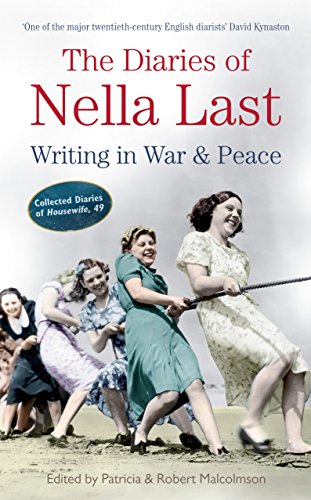
Book Cover: The Diaries of Nella Last: Writing in War and Peace.

Meet Nella Last. Nella was a diarist for Mass Observation, a social research organization launched in January 1937. Billed as the “anthropology of ourselves,” Mass Observation had a national panel of volunteers who replied to regular questionnaires on a variety of questions. Approximately 480 of these diaries were written during World War II. Nella’s diary has been much studied, with scholars releasing four volumes of her writings. In addition, her diaries were the basis of Housewife, 49, a British movie released in 2006. 

Reading Nella’s diaries, one can see how her life grew to embrace the war effort. The mother of two grown sons, her life had been rather limited by her husband’s cranky personality. However, once she joined the Women’s Voluntary Services, things changed for her. Now, the WVS was an organization that was originally focused on training women to help with air raid precautions in the lead up to World War II. By the end of the war, this organization was running emergency rest centers, feeding people and administering first aid, and assisting with the evacuation and billeting of children. According the BBC, one in every 10 British women was a member of this organization, the so-called “army Hitler forgot.”

Nella’s work in her community of Barrow-in-Furness included organising raffles to raise money, working for Central Hospital Supply Service and providing ‘comforts’ and other goods for the Sailors’ Home. She worked on both the “Jolly Roger,” a mobile canteen, and later in a stationary canteen. As the war progresses, she helps set up a Red Cross shop in Barrow, the proceeds from which were intended to raise money for its Prisoner of War Fund. She does all this even though she is tired and scared, even though she has to stand in line waiting for rationed food, even though she’s sick of having a bomb shelter in her living room. 

According to the editors of The Diaries of Nella Last: Writing in War and Peace (2012), her war work “[G]ave her a sense of purpose; it helped her to feel worthwhile – and to be acknowledged by others. It had been a sort of anchor; it liberated her from the constraints of domesticity –‘the cage of household duties alone’, as she once put it (15 August 1945). In many ways the war changed her life.” Nella, writing in March 1943, writes: ‘My job – or rather jobs – are all volunteering but I love them and the Red Cross shop is a great pleasure to me even if a great deal of work. I don’t feel I could ever settle down entirely to be a housewife again.’

Nella is another example of perseverance and grit. 

Source: Last, Nella. (2012). The Diaries of Nella LastWriting in War and Peace. Malcolmson, P., & Malcolmson, R., Editors. [Kindle Android version]. Profile Books.

See also: The BBC’s archived page about Nella’s diary. I’m not sure how long this will still be available.

File Under

Tags:

The Countess

The Countess

Let me begin this blog with the stories of two women, both British – one a countess, the other a housewife. Today’s story is about our Countess, a woman who managed to fluster the British military during World War II in an effort to serve her country while spending time with her new husband. Our countess is Hermoine Ranfurly nee Llewellyn who had moved to Australia at the age of 24 to become the personal assistant of the Governor of New South Wales. While in Australia, she met Daniel Knox, the 6th Earl of Ranfurly, and subsequently married him. When World War II broke out, her husband’s Yeomanry unit, the Notts Sherwood Rangers (part of the 1st Cavalry Division, later the 10th Armoured Division) was shipped to the middle-east. Hermoine wants to do her part, finding a job in London where her boss was – in her words – “too fast for me in every respect.” 

Desperate to be near her husband, she goes to a small travel agency and books herself a one-way passage to Egypt, in her attempt to get to Palestine. She lands a job as a secretary to the head of the regional Red Crescent in Haifa, but despite her best efforts, Brigadier Brunskill of the General Headquarters in Jerusalem says she cannot stay. To quote her diary: ‘You will go,’ he said, ‘on the first evacuation ship, very soon. You may stay in South Africa or proceed to England. You can’t expect me to believe that a Countess can type.’

By the end of September, our Hermoine finds herself with the other illegal wives, under military guard, on the S.S. Empress of Britain. Don’t worry, though: She slips off the ship in South Africa, writing in her journal on October 11, 1940: “I am going back to Dan.” She walks into a passport office in South Africa, obtains a 3-month visa for Egypt, secures a small loan from a bank, and gets on a flying boat back to Cairo, where – having spent the last of her money – shows up a friend’s house where she cannot pay the taxi driver. In her October 31 entry, Hermoine reports: 

Today Pam returned from GHQ to lunch in the flat. She was loaded with news: ‘Dan is coming with his General to Cairo tomorrow for two nights; the news of your return is out at GHQ and there is much gossip– some think it very funny but the authorities concerned are furious and suspect you must have used someone else’s passport as such care had been taken that you should not return. They are determined to ‘‘ make an example’’ of you and throw you out again. My girlfriend in the Provost Marshal’s office says the Military Police have been told to find you.

Hermoine, however, is incredibly resourceful. She finds a job working for the SOE in Cairo, and even then the military wants her deported. The Ambassador refuses to pull her passport, saying: ‘As you do not appear to be a white slave trafficker or involved with drugs, I cannot remove your passport.’ The Brits still want to send her home, appealing to General Jumbo Wilson. As her husband has been taken a prisoner of war, they were no longer in the same theatre of war, making the original order moot. At this point, Wilson adds: ‘This lady has outmanoeuvred every General in the Middle East and I do not myself intend to enter the arena.’

By November of 1942, General Jumbo – as she calls him in her diary – has taken Hermoine on as his own secretary. Her posts take her from Cairo to Algiers to Caserta (Italy). In late November 1944, her General is notified that he will be transferred to Washington, DC as the head of the British Joint Staff Mission. At first Hermoine is to go along to America, but the General’s wife objects and she is left behind in England. But, does this stop Hermoine from serving her country? No. She gets herself to back to Italy and secures a job with Air Marshal Slessor, continuing in this position after Slessor is moved to London towards the end of the war. 

Now, that’s grit.

Source: Ranfurly, H. (2014). To War with Whitaker: Wartime Diaries of the Countess of Ranfurly, 1939-45. [Kindle Android version]. Bello. [Primary Source: Diary] 

Tagged:

File Under: