On Intersectionality

A Brief Note about the 6888th:

Before we move onto other ways that women contributed to war efforts throughout the centuries, I’d like to briefly highlight the issue of intersectionality, a concept introduced by Kimberle Crenshaw in the late 1980s. The basic idea is that “when it comes to thinking about how inequalities persist, categories like gender, race, and class are best understood as overlapping and mutually constitutive rather than isolated and distinct.” 
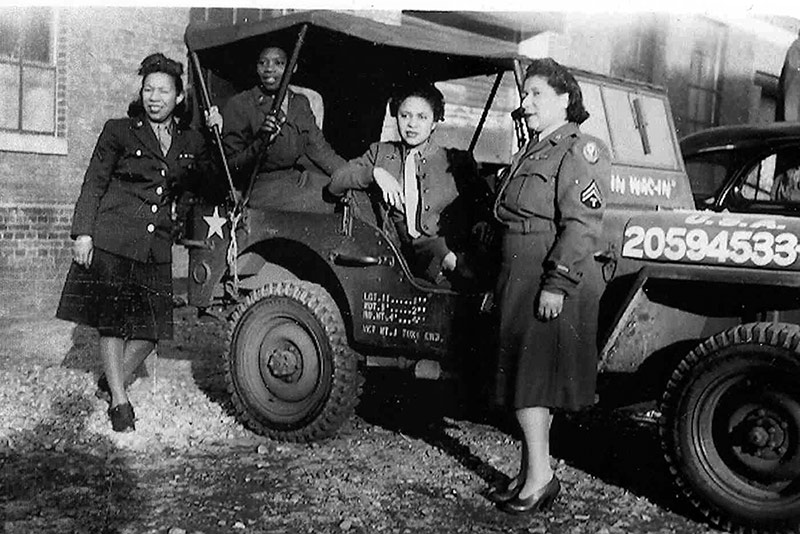
Four members of the 6888th Postal Battalion in Europe with an Army Jeep.
Members of the 6888th Postal Battalion in Europe.
Source: United States Department of Defense, reposted at the U.S. Army Center of Military History.

In her memoir, One Woman’s Army: A Black Officer Remembers the WAC, Charity Adams Early highlights the extra burdens that faced African American Women in the military – primarily the problems associated with racism and segregation. Yet, this woman showed an amazing amount of grit and ended up leading the 6888th Central Postal Directory Battalion. The battalion of African American WACS were first stationed in Birmingham, England, and later in France with one mission – get the mail to our boys at the front. According to the US Army Center of Military History, the women created a new tracking system, processed an average of 65,000 pieces of mail per shift, and cleared a six-moth backlog of mail in three months. 

Stories of Racism

Just to whet your appetite for more stories of the Six Triple Eight, I want to share this snippet from an article from the National World War II Museum entitled “The Six Triple Eight: No Mail, Low Morale” (February 10, 2021).

Imagine you’re a black woman leading a black platoon – the only platoon of African American women to be sent overseas. You’re in England and a visiting general decides he wants to see the women under your command march. What do you do when this general gets on his high horse with you? Do you stand your ground? Adams did. Read the following excerpt from “No Mail, Low Morale:”

It seemed like every weekend her troops were marching for one general or another. On this one occasion, a general arrived, but only 300 of her women were ready for inspection. The general wanted to know where the rest of the women were. Adams explained that one-third were on duty and the other third were resting. The general did not find that answer satisfactory. ‘I tell you what I’m going to do, Major Adams. I’m going to send a white first lieutenant down here to show you how to run things.’

Adams recalled that ‘there are times when the human mind must respond like a computer. That statement seemed like a scream.’ She did not remember which word triggered her response, but she was certain that her officers and soldiers in formation had heard the exchange. Adams realized that she might not be able to effectively lead her troops if she did not give the proper response, so she blurted out, ‘Over my dead body, Sir.’

The general assured her that she would hear from him. As she prepared for a court-martial, her staff found a memorandum from SHAEF headquarters that cautioned commanders about using language that stressed racial segregation. The general relented.

— James William Theres (2021, February 10)

And that, my friends, takes grit.

I am going to come back to these amazing women later in this blog after I have organized my thoughts a bit more. For those of you who want to know more about the Six Triple Eight, I recommend this article from the National World War II Museum (dated September 15, 2021). 

Sources

Earley, C. A. (2021). One Woman’s Army: A Black Officer Remembers the WAC (Texas A & M University Military History Series, #12) [Kindle Android version]. Texas A&M University Press.

Theres, James William. (2021, February 10). The SixTripleEight: No Mail, No Morale. The National WWII Museum. Last accessed October 6, 2021. https://www.nationalww2museum.org/war/articles/the-sixtripleeight-6888th-battalion

File Under

,

Tagged

Upcoming Entries: Women’s war contributions that pre-date World War II

Grit, Guts, & Glass Ceilings

Or: How Dr. Hallock Morris Picked Her Theme

Photo by Chelsi Peter on Pexels.com

Before we go too much further with this blog, I need to define the parameters of our “theme” of gritty women. I’ve named my blog Grit, Guts, and Glass Ceilings for a particular purpose. As I noted on the about page for this site, two summers ago, I proposed to do a presentation on women’s contributions to the war effort for The Albert H. Small Normandy Institute, a competitive program for talented high school students. Each year, fifteen student/teacher pairs are selected from around the country to participate in an eight-month program about World War II with its primary focus on the D-Day landings at Normandy. The highlight of the program – in most years – is a trip to Normandy, France. 

Unfortunately, Covid came along and cancelled the trip in 2020 so this particular class of scholars studied for well over a year before meeting in Washington, DC, and Bedford, VA. This extra year allowed me to read broadly (and deeply) into the lives of many women who helped with the war effort. Not only did I learn personal stories like the ones I shared in my opening entries to this blog, but I also had a chance to develop a theme. Originally, I had planned to write about Rosies, Land Girls, and military women. But, over these past two years, I realized several things, including:

  • Women made great spies and resistance workers because they were unexpected participants;
  • Women’s home front contributions were a form of war work which we often discount; and
  • Women’s work had an impact on the social norms of the day.

Most importantly, however, I found an underlying theme in all of the diaries, memoirs, oral histories, letters, and secondary sources that I’ve read: These women were good at their jobs because they all shared a commonality – they had grit. Like Elizabeth Warren (who you may not agree with politically, but I digress), “Nevertheless [they] persisted.”

So, what exactly do I mean by grit? In a nutshell, grit is a combination of spirit, guts, and courage. These are all things women showed during World War II, whether they joined the services, worked the land, assembled airplanes and ships, built bombs, or – in the case of British women – preserved through everyday life, figuring out how to feed and clothe their families while living through the Blitz and other bombings. But perhaps we need a more “scholarly” definition of this term. This comes from McArthur Genius grant winner and psychology professor Angela Duckworth, the author of Grit: The Power of Passion and Perseverance (2016). According to Duckworth, grit can be defined as “Passion and sustained persistence applied toward a long-term achievement, with no particular concern for rewards or recognition along the way. It combines resilience, ambition, and self-control in the pursuit of goals that take months, years, or even decades.” 

Women must have grit – guts, courage, and persistence – to break through what is commonly called the glass ceiling. A typical definition of the term sounds something like this: an unofficial limit which prevents some, especially a woman, from advancing to a top position in a company or organization. In political science, we talk about glass ceilings when we look at elected officials: Nancy Pelosi, becoming the first female speaker of the House, Kamala Harris, becoming the first female vice president in the United States, or Margaret Thatcher becoming the first female British Prime Minister. This June, Linda Fagan became the first female vice commandant and first female four-star admiral in the United States Coast Guard. As these barriers continue to fall, it’s hard for modern women to remember that there were significant cultural barriers in place to the women who wished to serve in the war effort during World War II. 

Keep these concepts in mind as you continue to follow along here at Grit, Guts, and Glass Ceilings. Although my early focus in this research has been on the World War II era, I am expanding my storytelling to include other conflicts and social movements, as well as political women’s history from the founding First Ladies to our current Vice-President and Speaker of the House. 

Upcoming entries: The Concept of Intersectionality.

Sources

“Admiral Linda Fagan Becomes USGC’s First Female Four-Star Admiral. (2021, June 21). The Maritime Executivehttps://www.maritime-executive.com/article/adm-linda-fagan-becomes-u-s-coast-guard-s-first-four-star-admiral?fbclid=IwAR1wdJON-2_U0oUQwUFJUe5a0m2dCGt3NzdBBmYnHnjfPvr3YgSD4Ux05V0 [Last accessed July 18, 2021].

Duckworth, A. (2016). Grit: The Power of Passion and Perseverance. [Kindle Android version]. Scribner. 

Fessler, L. (2018, March 26). “You’re no genius:” Her Father’s Shutdowns Made Angela Duckworth a World Expert on Grit.” Quartz at Work. https://qz.com/work/1233940/angela-duckworth-explains-grit-is-the-key-to-success-and-self-confidence/ [Last accessed July 18, 2021].

“Glass ceiling.” (2021). Cambridge Academic Content Dictionary. Cambridge University Press. https://dictionary.cambridge.org/us/dictionary/english/glass-ceiling [Last accessed July 18, 2021].

See Also (for Fun): True Grit in the Urban Dictionary.

File Under

Tags:

This is a Man’s War?

Let’s talk about the Gutsy Women of World War II! I’m back with resources, lecture notes, reading annotations, and all the other materials you need to build your own class about the role of women in WWII. — MT Hallock Morris

Video: It’s Your War, Too! Produced by the US Army Signal Corps and distributed under the auspices of The War Activities Committee of the Motion Picture Industry. Available on YouTube courtesy of The Best Film Archives.

The Gutsy Women of World War II

During the 2022 Spring Semester, I taught a nifty Honors Seminar entitled The Gutsy Women of World War II. This class was an outgrowth of the research I had conducted for a talk at the Albert H. Small Normandy Institute. [You can read the backstory here!] Although I am an associate professor of Political Science, I am a huge proponent of interdisciplinary research. Why stay in our individual academic silos when there is so much to learn out there? My research has since expanded to include other gutsy women – suffragettes, female politicians, and environmental activists. All of these women have a story, with a common theme: Grit. More specifically, they persisted when the odds were against them. 

What you are seeing here is a hodgepodge of ideas. You’ll see links to the sources I used to develop my course, annotations and summaries of readings about gutsy women, and my thoughts as they have continued to develop. My goal is to share what I found, to help support others as they delve into teaching the stories of these women. 

The Seminar: A Basic Description

If you’re a high school teacher, a college professor, a homeschooling parent, a student looking for information to write a paper, well, you probably want to know what I taught in this course. Here are a few excerpts from my course syllabus:

The Course Description

Land Girls, Leaders, Soldiers, Spies: The Gutsy Women of World War II. What did you do during the war, Grandma? From simple things such as rationing and planting victory gardens to serving as WACs and Marines, from being a nurse on the beach at Normandy to serving donuts behind enemy lines, from working as a “Rosie” to spying behind enemy lines, women played an essential role in helping the Allies win the war. Our focus will be on issues of gender, intersectionality, and leadership, as well as the “Grit and Guts” it took to survive the darker aspects of war – surviving the Holocaust, hiding Jewish children in convents, and flying night raids over the enemy. As a part of our work, you will learn how to use USI’s archival resources to help build a popular history podcast on the Gutsy Women of World War II. 

Note: This course was offered as a 1-hour honors seminar at the 100-level. The course met in person one day a week for 50 minutes. We had two weeks where the meeting was online (I was at a conference one week, I was out with COVID symptoms the second time). We also had one day that was cancelled due to inclement weather. We had a speaker during one class session who talked about the practicalities of developing a podcast and/or radio documentary. We also had one class period where we toured the University’s archives and special collections.

Honors Program Student Learning Outcomes

Connections among Disciplines. Students will demonstrate an understanding of interdisciplinary inquiry into complex problems.

Research and Creative Skills. Students will demonstrate the skills necessary to do independent research or creative projects and present their work to faculty and peers.

Community Engagement. Students will demonstrate leadership and active membership in various communities, including the Honors Program, USI, and the Evansville community.

Ethics and Morals of Citizenship. Students will demonstrate an understanding of the ethical and moral obligations of being an informed and engaged citizen in a diverse and global community.

Course Learning Objectives

Students will demonstrate understanding of the role of women in World War II from the perspectives of political science, history, and women’s studies.

Students will demonstrate strengthened skills important to success in Honors and undergraduate education, including reading skills, critical and creative thinking skills, and communication skills (written and oral) by using both primary and secondary materials to develop script materials for popular history podcast.

Students will demonstrate understanding of the impact of the topic on current global issues by examining the historical issues of intersectionality and exploring the roots of modern societal expectations of women.

The Textbook & Other Materials

Yellin, Emily. Our Mothers’ War: American Women at Home and at the Front During World War II. New York: Free Press, 2005. 

Note: This is an older book and it didn’t cover all of the topics I wanted to cover in the class. I augmented the book with various articles and videos that I linked through our course website. Furthermore, because one of the goals of the class was to look at Evansville’s (IN) contributions to the war effort, I also had two public history books on reserve at the campus library. These were:

MacLeod, James Lachlan. 2015. Evansville in World War II. Charleston, SC: History Press

Bingham, Darrel. 2005. Evansville: The World War II Years. Charleston, SC: Arcadia

Our Weekly Topics

Week 1. Precursors
Week 2. Unearthing Our Mothers’ War Years
Week 3. Soldiers Without Guns – The Rosies
Week 4. Putting Up a Good Front – Entertainers, Fictional Characters, & Icons
Week 5. This Man’s Army, Part I – WAC, WAVES, SPARS, WASPS, and Marines
Week 6. Save His Life and Find Your Own – Volunteers, Land Army, Red Cross Girls, and Nurses
Week 7. Jane Crow and Questions of Loyalty – African American and Japanese American Women
Week 8. More on Intersectionality – Mexican American Women War Workers
Week 9. British Women on the Homefront – Victory Gardens, Jambusters, and Make Do and Mend
Week 10. British Spies, American Spies
Week 11. France, Belgium, and the Philippines – Resistance Efforts and Freedom Lines
Week 12. The USSR – Night Witches and Snipers
Week 13. Bad Girls – Red Light Districts, Social Mores, and Sexuality
Week 14. Victims and Survival – Comfort Women, Rape, and the Holocaust
Week 15. The Aftermath – Backlash, the Roots of Feminism, and Iconic Visions

Note: I issued a trigger warning for Week 14 because these can be uncomfortable topics. Here is what I stated:

This discussion may be uncomfortable for some students. Descriptions of the rape of Nanking, the forced prostitution of Korean women, and the treatment of women in concentration camps may be graphic. Please see me if you need an accommodation for this week.”

— HONS 129.H04 Syllabus | Spring 2022, University of Southern Indiana

About Week 13: I’m a college professor and my class was filled with individuals who were 18+. I’m also pretty open when it comes to talking about sex because I feel that honesty is the best policy. However, I am also married to a high school social studies teacher — and he has adamantly stated that he would never cover these topics in class. I suspect that your comfort level with these issues depends on where you live and teach in the USA.

So What’s Next?

Stay tuned. We’re going to start our journey with the tale of a countess and a housewife, followed by a short story about the 6888th Postal Battalion. Next week, you’ll be introduced to the women warriors of years past and to the Hello Girls. If you’ve been here before, these are reposts from last fall. All new material starts next Wednesday!

Tagged:

File Under:

,

Dated: